Showing posts with label college. Show all posts

Martindale Literary Prize for Short Fiction


Remember that short story contest I mentioned a little while back? Well, somehow---I won! For a short story I first wrote in 2007, called "Wet Season."

I still can't quite believe it. My first writing prize! And the first time I've actually made money through my writing. I totally got all teary and shaky when they called me up to the little podium last night, even though I'd promised myself that I wouldn't.

They made the announcement at the opening reception for the 2009 Pima Writer's Workshop. A reading by Peter Turchi, (the judge for 2009 and a faculty member at the workshop), was the main event.

Linda Lyons won second runner-up for her story "Footsteps." Tom Printsner (sp?) won first runner-up for his story "Leonard and Martha," but unfortunately he was out of town.

Peter Turchi was nice enough to sign my copy of his short story collection, Magician, even though I was all mumbly and nervous.

Meg Files was super-sweet, and she signed my copy of her craft book, Write from Life. (Laura Van Etten, my workshop instructor from this past semester, gave that to me as a going-away-to-Minneapolis present! If you're ever looking for a writing class in Tucson, check out one of Laura's, it was great. And she recommends Meg Files' class highly. Judging by this book, I absolutely agree, and I'm sorry I never had the chance.)

Nancy Wall gave me the call to tell me, last Tuesday. She was really nice. I cried. She made me promise not to tell anyone until after the announcement---it was so hard to keep my mouth shut!

Nancy Wall, reading Peter Turchi's comments about "Wet Season." Meg Files, taking a picture.
(PLEASE disregard my terrifyingly bad posture, eesh.)


Peter Turchi was the judge for 2009. Here he is reading his work. (Pardon the craptastic photo quality.)

Linda Lyons getting her certificate from Nancy Wall

Meg Files, Chair of the Pima English Dept. and Pima Writer's Workshop founder

It's called the Martindale Literary Prize. It's an annual prize for short fiction, it began in 1988. The rules are that you can only submit one unpublished story, you can't have won before or be Pima faculty, the story has to be between 5,000 and 10,000 words AND you have to be taking at least one class at Pima Community College---so the applicant pool is pretty much limited to people in Tucson.

And the award is $1000! I'm still hyperventilating. I can't even explain how much this will help with my move to Minnesota. Things have been looking really grim on my financial front, lately.

As much as the money saves the day for me, this really does mean even more to me on an emotional and professional level. I feel SO grateful and so lucky. I hope this post doesn't come off as braggy, because that's not what I want. I'm just really happy---the MFA, and now this? It's like the world is telling me: Go ahead, do this. I've got your back. (And I go: Well, I was going to go for it anyway, but this really helps!)

The prize is a bit obscure, I have to admit. You'll have trouble finding information about it on the internet---apparently they don't have a website set up for it. (I'm tempted to ask them if they'd like me to make one for them! But I know that's crazy talk.)

So please forgive me---I'm going to indulge myself a bit here, and tell you everything you'll ever never want to know about the Martindale Literary Prize.

I'm warning you ahead of time. I'm going to blab and blab, so feel free to skip this. Okay? Okay.


Kaleidoscope, published by Pima Press in 2007.
Kaleidoscope is an anthology of nineteen winning stories from a yearly contest at Pima Community College in Tucson, Arizona.

The competition, sponsored by the Martindale Educational Foundation, awards an annual prize of $1000. As Mr. Robert C. Martindale explained in 1987 at the first meeting to discuss this competition, his foundation was offering a substantial award, and he therefore expected substantial stories.

The judge for each year's competition is a well-known fiction writer, and all of the judges have commented on the unusually high quality of the work submitted. Several of the authors appearing in Kaleidoscope have had short story collections or novels published, while the work of others has appeared in serious literary journals, some publications containing the stories from this anthology.

Hey, wanna know who won the Martindale in 2000? Tayari Jones! Remember when I read Leaving Atlanta and loved it? She did her MFA at ASU, and she's fiction faculty at Rutgers-Newark now. The Untelling is on my list of must-read-soons.

Here's the flier that started this whole thing:


Wanna know what's funny? Peter Turchi and Charles Baxter (faculty at Minnesota) edited a book on craft together! It's called Bringing the Devil to His Knees: The Craft of Fiction and the Writing Life. Turchi was the director of the Warren Wilson MFA program from 1993-2008, and Baxter still teaches there, I think.

In case you're thinking, Hey, that sounds fishy!, let me assure you that this is just a wonderful cosmic coincidence. Check out the flier: They didn't say who the judge would be, and Turchi never saw my name. Even if he had, I can promise you that at this point I've said about seven words to Charles Baxter, (Hello, it's so good to meet you), and he has no idea what I'm doing with my insignificant little summer, or what kinds of longs shots I'm shooting for. Turchi did his MFA at the University of Arizona, so really it's not so strange that he's here to do the Workshop. But I just love unexpected connections like this.

*

What about the story? "Wet Season" was part of my MFA application portfolio. I wrote it for a summer fiction workshop taught by the excellent Rachel Yoder. At the time she was an MFA student at the University of Arizona. It was my first creative writing workshop, and she was just such a really engaging, dedicated, supportive teacher. Please, please go check out NewPage's review of Alligator Juniper, Prescott College's literary journal---she edited this issue!

I've revised the story a few times already, and I plan to keep working on it. After taking Laura Van Etten's awesome short fiction workshop this past semester, I realize that what I probably need to do is go back and cut, cut, cut. She has this way of saying things that really made stuff make sense to me in all kinds of new, sparking and/or comforting ways.

If you check out my earlier post, you'll see that I submitted this story to a few other contests/journals, and struck out. I guess it goes to show---just keep trying! You never know.

*

While I'm at it, I'd like to thank:

(Well, my family, of course, and S. But those are givens! Always.)

Rachel Yoder, Emily Lundin, Alison Hawthorne Deming, Manuel Muñoz, Laura Van Etten, Carlos Gallego, Tenney Nathanson, Judy Blunt, Terry Woronov, Praise Zenenga, Bridget Radcliff, Wendy Burk, Susan White, Ilham Khuri-Makdisi & Ron Grant. Thanks for being such inspirational (& dedicated!) writers, teachers and advisors. Your classes & workshops/story-essay-poem comments/advice, guidance & encouragment/recommendation letters/help ETC! have made such a huge huge difference in my life. Many of you probably have no idea what a big impact you've had on me---I really ought to do something about that.

There are SO many more wonderful teachers I'd like to mention here, but it would take miles...I hope you know who you are.

Not that most of these folks are likely to see this : )

*

Phew! It's ridiculous how long I've rambled on. Goodnight, world!

THE DOG OF THE MARRIAGE, by Amy Hempel


You're probably wondering where all the "fiction" is---I've been wandering---so I thought I'd share this little review. I wrote it for a summer intro-to-fiction class. It could use some editing, but I'm sleepy, so I'm just shaking it off and setting it out to air.

Don't laugh, or better, do.

Goodnight : )


*
HERE BE SPOILERS!*


On Amy Hempel’s The Dog of the Marriage

(me, 7/2/07)


Amy Hempel’s collection of short stories, The Dog of the Marriage, is like a short series of small windows into large lives, lives belonging to women only slightly different from one another. At times, reading through the collection, it felt as though one character, one self was almost progressing into the next, also seeping into the reader---myself, as I continued down the trail.

All of these stories are written in the first person. There is a sort of flickering identity shared between the characters in this book, hard to put your finger on, and personally I suspect that this unifying “essence” is something from the life-breath of Hempel herself. The voice changes but is never unrecognizable, and I found this continuity to be very satisfying. Reading this book was like getting to look at one thing from nine subtly different insides, so that when the time came to part with the stories, I truly felt like something had been swapped between the complete work that I had read and myself.

These stories are about relationships, not-so-strangely enough. Besides the continuum of characterization already mentioned, the other element that brings these stories so close together is the unifying theme of “desire.” Hempel prefaces the collection with this hauntingly evocative little passage, an expression of the “thing” that these stories look at:

But the greatest desire of all is to be
In the dream of another,
To feel a slight pull, like reins,
To feel a heavy pull, like chains.
—Yehuda Amichai

After finishing Hempel’s book I felt as though I understood Amichai’s sentiment in a much deeper, more complex way than when I turned the page to the first story: these stories are about the need to be loved (needed, wanted, desired) and what happens when we’re not, what it means to hold on and what it means to let go. What it means when we are held onto, what it means when we are let go of.

Some of these stories, like “Jesus is Waiting,” “Reference #388475848-5” (which takes the epistolary form) and “Offertory” examine what it is to try to reach out, to come together.

The narrator in “Jesus is Waiting” desires unabashedly and without reason until a point of absurd, fragile beauty is reached. Maybe all of the stories in this collection are about that, in some way.

Offertory” and “The Afterlife” in particular also seem to ask not only what wanting is, but what memory is, how memory serves to tie us to ourselves and to others—how these old memories, these old desires can either come between or hold together, and what the consequences are of each.

Beach Town” seems to look at the ways in which we overhear the lives of others. Although the narrator does not really indulge in self-reflection, I think that this story asks us to reflect on how this kind of “taking in” can affect our own lives. After all, that’s what we do when we read a story (eavesdrop on the neighbors, watch a film, remember an old lover): we “overhear” someone else’s life, and hope to be changed in some way by doing so.

The namesake story of this collection, “The Dog of the Marriage,” is in itself a smaller series of even more fluidly connected lives. These four small pieces add up to a single expression that examines guilt and regret and a feeling that is not quite sentimental enough to be loneliness. I would describe the feeling expressed and explored within these stories as being more like an almost clinical sort of solitude, a solitude that comes with trying to turn certain things off within yourself, with trying to learn to feel resigned to things, or pretending you’re not. The “dog” in these marriages is not always of the canine variety, and the actual dogs are often far more faithful than the people. The “marriages” are usually anything but.

It is not always a comfortable or enjoyable experience, being drawn into the minds of these women, but it is always a stirring experience. “The Uninvited” is about what it is to be “loved” not just badly, but violently. What happens when the need (desire) to be loved becomes twisted within a person, and what it’s like to have that twisted desire forced upon you, on your body. The story is narrated by a 50 year-old rape counselor who has herself recently been raped by an acquaintance. She is afraid she might be pregnant, but has not followed the advice that she has given so many others over the years: she has not reported her attacker. She is feeling guilty for falling victim to her attacker even though she has spent her life teaching others not to. She doesn’t want to have to explain that she instinctively knew how to respond in order to save her life...that she pretended to love the rapist so he wouldn’t kill her.

In “The Uninvited,” Hempel uses an old film, from which the story takes its name, to draw unstated parallels and bring us into the narrator’s usually unspoken inner thoughts and conflicts. Just as the narrator wonders “to whom the title refers [in the movie]—to the ghosts or to the guests,” we are left thinking about not only the rapist she made the mistake of inviting into her home, but the seed she fears may have been planted in her womb.

The story “Memoir” lasts only one sentence, and I think it sums up with a beautiful succinctness what this collection is saying better than I ever could:

Just once in my life—oh, when have I ever wanted anything just once in my life?

This speaks to the feeling I got from these stories that they constitute a cycle or progression, and maybe to the idea that there are no beginnings or ends in this collection, only different kinds of desire.

I remember that some of the stories I’ve read from Hempel’s previous collections seemed to leave me with a sort of welling-up, while most of these made me feel a kind of settling-in, a “what-is-this?” digestion more than a “that-was-that” emotion. Most of these stories seem to avoid (surpass?) the traditional or basic idea of what story and plot are. They can be fragmentary, they move around in time. They have very open endings and often the crisis “moment” actually seems to be the entirety of the story. Resolution usually seems to be something that we as the readers need to reach for, instead of having it handed to us.


Hempel leaves us at just the tip of something with each of these. We must take the conflict within ourselves as we read each story (and she makes this easy with her attention to detail, voice and moment) in order to be able to understand the inertia of each piece. It is only by taking an active role in the experience that these stories “offer” up that we are able to see where it is that Hempel is pointing, and that is one of the many wonderful things about this wonderful collection of short stories.

end


*

PS---By the way, my cat threw up on this book (just a hairball) soon after I finished reading it, and I was really, really upset with him about it. After stomping around the living room for a while, I washed the dustcover, and I kept it. Now there's a funny little stain. Don't judge. Boots is forgiven.

In Memoriam: Dr. Trudy Griffin-Pierce


Dr. Trudy Griffin-Pierce
just glowed with kindness. She was such an earnest and sincere person, so genuinely warm---radiant.

She taught the Anthropology senior capstone I took my last semester at the U of A. The minute she walked into class the first day, I knew that I really liked her. (Maybe she was wearing one of her homemade skirts, maybe the knee-length turquoise one with the white zigzag trim---she seemed so young, in such a true and honest way, in such an essential way.) Just being in that room with her made me feel smiley inside. There was something about her.

She died on January 6th, 2009, not long after the end of the semester. I feel lucky to have met her, to have had the pleasure of hearing her talk about her life and work, to have had her class as my last Anthropology course at the U of A.

She had us keep journals where we wrote about various snippets from our lives (a song, a story in the news, an outing, a class, anything.) We were then to take each experience and analyze it through an anthropological lens---angling at it either from a cultural, linguistic, biological or archaeological perspective. She wrote the kindest things in my journal, and I'll treasure these notes always.

Here is a little clip from what she wrote (one of the notes that tells a little bit about who she was and is):

"And your entries about Barack Obama were so very moving---yes, indeed, as someone who was in high school & university in the the 60's and 70's, I finally feel like this country is moving again, "standing up for something."

Thanks for being a generous teacher and an inspirational person, Dr. Griffin-Pierce. You will be remembered with love, even by those of us who only skimmed across the surface of your life for the very briefest of moments.


*

From an article at the Arizona Daily Star:

Trudy Griffin-Pierce: Navajo culture, beliefs were her inspiration

By Kimberly Matas, 02.02.2009


Anthropologist Trudy Griffin-Pierce didn't want to observe the rituals and elaborate spiritual ceremonies of the Navajo: She wanted to live the life of the Diné.
Though of Catawba Indian heritage and born in South Carolina, Griffin-Pierce was fascinated from childhood by the Navajo, said her aunt, Pat Wells of Florida. Diné, meaning "The People," is the name Navajos use for themselves.

"I remember her saying from the time she was 3 years old she had this interest," Wells said. "She had a children's book about Native Americans and she remembered her interest going back that far."

The Navajos' complex spiritual beliefs are based on Hózhó, which means existing in a state of balance, harmony, wellness, peace and completeness.

Griffin-Pierce, an associate professor of anthropology at the University of Arizona, learned about Hózhó and other spiritual and cultural beliefs when she was informally adopted by a Navajo family in Northern Arizona. She learned about healing practices and ceremonial sand painting and that death is not to be feared because it is part of nature's course.

And it was Jan. 6 that 59-year-old Griffin-Pierce entered into the next phase of the ongoing cycle of birth, life and death. She died suddenly at home with her beloved sheepdog, Mr. Skippy, at her side. The cause of death is not known.

[...] While studying for a bachelor's degree in fine art from Florida State University, Griffin-Pierce wrote to the chairman of the Navajo Nation, asking him to find her a traditional Navajo family that she could join.

"I wanted to live with them as a daughter, not as an anthropologist. To learn from them, not about them," she said in a 1992 Arizona Daily Star article.

"I lived with them in their hogan, and I didn't speak any Navajo, and they didn't speak any English," she said. "Every morning, I'd go out and herd sheep all day, and I'd ride the buckboard into the trading post with them, too."

Avery Denny, a professor of healing, culture, oral history, and Navajo philosophy at Diné College, in Tsaile, Ariz., was her adopted Navajo brother. Until Griffin-Pierce learned the language, Denny and his wife translated conversations between the anthropologist and his parents, who were practitioners, or "chanters," and sang at healing ceremonies.

Unlike most anthropologists, who observe a culture from the outside over a period of hours or days or weeks, Griffin-Pierce immersed herself.

[...] Denny and Griffin-Pierce, whose graduate work focused on cultural and medical anthropology, were working on a presentation for a Navajo studies conference in Shiprock next month on diabetes. Along with her teaching duties, Griffin-Pierce also was working with the Arizona Alzheimer's Consortium to provide outreach and education services to the state's tribes.

After finishing her master's degree in museum studies, Griffin-Pierce worked as curator of a small museum at Kitt Peak National Observatory. It was at the observatory that she met her future husband, Keith Pierce, an internationally known researcher of solar physics who was instrumental in selecting Kitt Peak as the site for the observatory. He also played a key role in the development of the McMath-Pierce Solar Telescope.

Griffin-Pierce earned a Ph.D. in cultural anthropology in 1987 and began teaching at the UA a year later.

As a teacher, she inspired her students.

[...] "She wanted to know who we were as people, why we were taking this class, what we wanted to gain from it. She wanted to get to know us as people," Garcia Dixon said.

It was that interest in others that helped Griffin-Pierce make and keep many friends from all over the world.

[...] Sue Raymond, who met Griffin-Pierce in Hawaii in 1959 when their fathers were stationed at military installations there, became a lifelong friend.

"She always saw the good in everybody; she saw the good and she saw the potential," Raymond said.
*

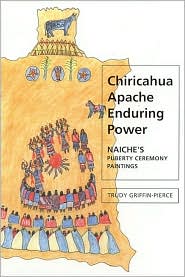
Dr. Trudy Griffin-Pierce wrote 5 books, including Earth Is My Mother, Sky Is My Father: Space, Time, and Astronomy in Navajo Sandpainting, Native Peoples of the Southwest and Chiricahua Apache Enduring Power: Naiche's Puberty Ceremony Paintings, Native Americans: Enduring Culture and Traditions and The Encyclopedia of Native America.

In addition to being an anthropologist, writer and teacher, she was also an artist. Her books include many of her own illustrations.


*

Here is a link to her memorial site.


This picture (with her dog Mr. Skippy), was taken in 2008 by Sandy Arbogast,
and is from the online slide show at her memorial site.


Extraordinary Spirit: A Tribute To The Life Of Trudy Griffin-Pierce
will be held in her honor tomorrow, April 18th 2009, here in Tucson.

Tucson Festival of Books


So, tomorrow morning marks the start of the very first Tucson Festival of Books!

Here is a link to maps and schedules, and here is the festival blog.

The UA Poetry Center has a list of their events.

The Pima County Public Library has a page about the festival.

There's an entry about it on the NewPages blog.

The Arizona Public Media page features video.

They even have a Facebook page.

And here's a clip about the festival on Youtube.

*


Here's what I'm thinking for Saturday:

Poetry readings by
Alison Hawthorne Deming and Luci Tapahonso will be the first of the day. Former U.S. Poet Laureate Billy Collins will be giving a reading to close the day out.

I'm also really interested in a talk called "Fiction out of Friction: Evolution, Arabs and Other Controversial Topics," with Robin Brande and Laila Halaby. Unfortunately, it's at the same time as Prof. Deming's reading! I will happily choose to go see my former teacher, but I hope I'll have a chance to hear about the Halaby/Brande talk.

Also at the same time is a talk on "Public Speaking for Shy Writers" with Michael Charton. Too bad!

My next pick: Fenton Johnson, Beth Alvarado and Naomi Benaron will give a talk on "Shaping Truth in Memoir and Fiction."

It's at the same time as two other talks that sound interesting: "Life Worth Living, Inside Out: The Sufi and the Sage," with Albert Clayton Gaulden and Mansur Johnson..."Oral History and Community Story: The Foundation and Inspiration of Fiction Writing," with Patricia Preciado Martin.

Later on, I plan to attend this very nifty panel discussion, which is one of the events at the UA BookStore:
Jason Brown, Kevin Canty, Ander Monson & Manuel Munoz

"The Writing Life: Surviving & Publishing in Today's Market"

And then this one:
Aurelie Sheehan and Laura Fitzgerald

"Art or Craft? What Makes Fiction Work and Why?"


That means I'll miss a talk on "The Art of Eavesdropping," with Stephen Kuusisto. (We just did an exercise on dialogue and eavesdropping in the community college workshop I'm taking.) And a talk called "In the Driver's Seat: The Character-Driven Plot," with Elizabeth McKenzie, Alfredo Vea and Ann Cummins. And one called "We Cannot Look Away: Exploring a Social Conscience Through Writing," with Stella Pope Duarte...tempting.


Of course, this is a pretty ambitious schedule. And I'm giving up my precious "sleeping in" days, so hopefully all the literary excitement will keep my energy levels high. But seriously, what an incredible opportunity, right here in Tucson. Hooray!


*


On Sunday, I plan to go see the

"KALACHAKRA" SAND MANDALA

Viewing & Dissolution Ceremony
for the Wheel of Time, Sand Mandala with respected Buddhist scholar and former attendant to the Dalai Lama, Losang Samten.

More soon...

Details, Details


I have to give a presentation on "authenticating details" today. It's an assignment for my community college fiction workshop. It's just beginner's stuff, because it's really an introductory level class. But it's keeping me honest, and I have plenty to learn. Plus, this kind of thing is probably good practice, considering I'll be teaching sometime soonish! I can hardly believe it, me---teaching. Exciting and strange.

This is from the handout I made (I have a partner, but I'm only including the parts I prepared):


*

Authenticating details are details that reveal something particular about who a character is—something about their personality, background, situation, emotional state etc. When these kinds of revealing details are specific and unique, they work to make us believe the character—they authenticate the character for the reader.

Sometimes, authenticating details are called significant details. This is from pages 26-29 of Writing Fiction: A Guide to Narrative Craft, by Janet Burroway and Elizabeth Stuckey-French:


Specific, definite, concrete, particular details—these are the life of fiction. Details (as every good liar knows) are the stuff of persuasiveness. (26)

A detail is “definite” and “concrete” when it appeals to the senses. It should be seen, heard, smelled, tasted, or touched. (26)

The [...] writer must deal in sense detail [and] these details must be details “that matter. [You must] mean more than you say. (27)

A detail is concrete if it appeals to one of the five senses; it is significant if it also conveys an idea or a judgment or both. The windowsill was green is concrete, because we can see it. The windowsill was shedding flakes of fungus-green paint is concrete and also significant because it conveys an idea that the paint is old and suggests the judgment that the color is ugly. The second version can also be seen more vividly. (27)

[...] if you are to realize your characters through detail, you must be careful to select the details that convey the characteristics essential to our understanding. You must select the significant. (29)

No amount of concrete detail will move us [...] unless it also implicitly suggests meaning and value. (29)


Writing Fiction also points out that “active verbs [...] tend to call forth significant details” (34). Here is a comparison from the book:

A general verb creates a general impression, but a precise, active verb conveys the exact picture in the reader’s mind. For example:

General Specific

walk------ Does the waiter scurry or amble?
yell------- Does the coach demand or bellow?
swim----- Does the child splash or glide?
climb----- Does the hiker stumble up the hill or stride?


Exercises, from page 203 of John Gardner’s The Art of Fiction: Notes on Craft for Young Writers:

Describe a landscape as seen by an old woman whose disgusting and detestable old husband has just died. Do not mention the husband or death.

Describe a lake as seen by a young man who has just committed murder. Do not mention the murder.

Describe a building as seen by a man whose son has just been killed in a war. Do not mention the son, war, death, or the old man doing the seeing; then describe the same building, in the same weather and at the same time of day, as seen by a happy lover. Do not mention love or the loved one.


*


We also have a few examples, and our own little exercise, involving
this picture from Found Magazine.

Short Story Contest (Rejections)

I'm taking a short story workshop at my local community college. Since I made the mistake of graduating from Local University in December (why, why, why?!) I have months and months to kill before starting an MFA this fall. I want to bring some new stories with me, and I want to make sure I stay in practice. Also, I'm switching my focus from creative nonfiction (undergrad) to fiction (grad), so a little part of me feels like I need to "catch up" somehow.

Our instructor handed out a flier about a local short story contest, which is apparently open only to students enrolled in least 3 credits at the college. So I'm thinking that the applicant pool can't be too very big. But get this---the prize is $1000. Can you say holy what-what?

I could really use that money. (See my mini-rant on unemployment, below). I have a story I'm thinking I might submit---it doesn't hurt to try, I guess. I already submitted it (rather foolishly) to a Glimmer Train "Family Matters" contest, One Story, and Alligator Juniper's national contest. I think I paid a total of $25 for the contest entries.

I was rejected, rejected, rejected. And no surprise, I understand why. It can definitely use more work, and quadrillions of "real" writers submit to those journals.

On the other hand, it was part of my MFA sample, and so far I know that it (and another story) got me into at least one wonderful program. And this contest has no entry fee.

So maybe I'll have a chance at this thing?