Showing posts with label society and culture. Show all posts

WRITE WHAT YOU KNOW: LIMITING OR AUTHENTIC? Blog post at Racialicious, by Neesha Meminger

I want to talk about this excellent, thought-provoking Racialicious guest post, by Neesha Meminger, when I'm not so tired. Here are a few excerpts:

Is it cool for white people to write from the perspective of people of color? How about [...] for men to write from the perspective of women? [Etc, right?]

[...] in an interview on ustrek.org, Sherman Alexie, author of Ten Little Indians and The Absolutely True Diary of a Part Time Indian, as well as the writer/director for Smoke Signals, jokingly suggested a “10-year moratorium for white writers so that Indians can tell their own stories instead of having white people tell them. ‘The fact is, when white authors step away from their typewriters, they’re still white. When I get up from the typewriter, I’m still an Indian.’ He wants those authors to question their privileged positions.”

So maybe that is the key: questioning our privileged locations within the social and economic framework within which we all live, write, and create, and then allowing that new consciousness or awareness to shape our work before we set it free to impact and help culturally define our world.

Alexie’s statement seems less about the products being created, and more about the systems in place that privilege and advantage some over others. In other words, rather than continually going to authors and filmmakers who already have a voice and platform, perhaps authors and filmmakers from under-represented communities should be sought out and nurtured/cultivated so that they can find, hone, and have their own voices heard.


[...] As a South Asian author writing YA, I know from experience that many editors are hesitant to pick up more than one novel with an Indian-American protagonist written by an Indian-American author – even if the two novels are different genres and about entirely different subjects – because both novels still fall under the Multicultural category. This often creates the “everyone elbowing for the one seat on the bus” phenomenon among the marginalized authors who have to fight for that one lone multicultural spot. But I digress…

Yet, as we all know from visiting our local bookstores, or taking an online stroll through Amazon, there is an abundance of books/films by white writers writing on every subject, in every genre – with more than one writer often covering the same topic for varying perspectives. A publishing house can have several white fantasy authors and historical romance authors, even a few writing about spiritual journeys and all of those books are seen as different books. None of my white author friends have ever had their agents come back to them with, “No, this editor declined because she already has a European title about identity issues.”


I, on the other hand, have heard that exact same phrase, substituting “European” with “Asian.” [...]

So, my question is this: would having more white writers producing books and films about people of color help writers of color? Would it be beneficial for there to at least be characters of color out there for people to read about and watch on screen, regardless of who writes them?


If white writers or filmmakers write and create the experiences of people of color, does this open doors for authors and filmmakers of color?


And what about the “limiting creativity/artistic expression” argument? Is it reasonable to ask white or male writers and filmmakers to “take responsibility” for the images they produce? What if we extend this to say that authors/filmmakers who have not experienced rape cannot write about or create films about rape? Or artists who have not lived in another country cannot write about or produce films about living in that country?


What about the converse: if men cannot write from the perspective of women, and white writers from the perspective of people of color, then what about women writing from the perspective of men? Or people of color from the perspective of white people?


What say you, oh Racialicious readers? If someone were to write a book or make a film about your life, who would you want telling your story? Would it matter what their background was? Or would you rather have someone teach you how to use the tools of the trade effectively so that you could tell your own story?


Meanwhile, go read the rest of it, and check out the discussion over at Racialicious. What do you think?

Where Is the Justice for Troy Davis?


From Amnesty International:

Troy Davis was convicted of murdering a Georgia police officer in 1991. Nearly two decades later, Davis remains on death row – even though the case against him has fallen apart. Davis’ conviction was not based on any physical evidence, and the murder weapon was never found. Since his trial, seven of the nine eyewitnesses have recanted or contradicted their testimony, and one of the remaining witnesses has been implicated by nine others as the actual murderer.

BREAKING NEWS: On April 16, by a 2-1 vote, the 11th Circuit Court of Appeals denied Troy Davis' petition.


The Court extended Davis' stay of execution for 30 days to give him a chance to file a habeas corpus petition with the US Supreme Court.


Please, help demand clemency for Troy Davis.

I know it's been kind of a bummer around here lately---but sometimes it's just overwhelming, all the sadness out there. We can help, and at the very least, we can care.


"You Are Being Lied to About Pirates," by Johann Hari

WTF---NUCLEAR WASTE?!

How did I not know about this? Why aren't more people talking about this?

I'm really glad to see there are people out there taking a multi-angled view of this pirate mess. There's so much human suffering involved, and there's more than one place to lay the blame.

(I know, I know---this place is completely scattered. But please just go read this article over at the Huffington Post.)

"You Are Being Lied to About Pirates," by Johann Hari


You Are Being Lied to About Pirates

Johann Hari, Columnist, London Independent
Posted April 13, 2009 | 10:05 AM (EST)

[...] The words of one pirate from that lost age - a young British man called William Scott - should echo into this new age of piracy. Just before he was hanged in Charleston, South Carolina, he said: "What I did was to keep me from perishing. I was forced to go a-pirating to live." In 1991, the government of Somalia - in the Horn of Africa - collapsed. Its nine million people have been teetering on starvation ever since - and many of the ugliest forces in the Western world have seen this as a great opportunity to steal the country's food supply and dump our nuclear waste in their seas.


Yes: nuclear waste. As soon as the government was gone, mysterious European ships started appearing off the coast of Somalia, dumping vast barrels into the ocean. The coastal population began to sicken. At first they suffered strange rashes, nausea and malformed babies. Then, after the 2005 tsunami, hundreds of the dumped and leaking barrels washed up on shore. People began to suffer from radiation sickness, and more than 300 died. Ahmedou Ould-Abdallah, the UN envoy to Somalia, tells me: "Somebody is dumping nuclear material here. There is also lead, and heavy metals such as cadmium and mercury - you name it." Much of it can be traced back to European hospitals and factories, who seem to be passing it on to the Italian mafia to "dispose" of cheaply. When I asked Ould-Abdallah what European governments were doing about it, he said with a sigh: "Nothing. There has been no clean-up, no compensation, and no prevention."


At the same time, other European ships have been looting Somalia's seas of their greatest resource: seafood. We have destroyed our own fish-stocks by over-exploitation - and now we have moved on to theirs. More than $300m worth of tuna, shrimp, lobster and other sea-life is being stolen every year by vast trawlers illegally sailing into Somalia's unprotected seas. The local fishermen have suddenly lost their livelihoods, and they are starving. Mohammed Hussein, a fisherman in the town of Marka 100km south of Mogadishu, told Reuters: "If nothing is done, there soon won't be much fish left in our coastal waters."


This is the context in which the men we are calling "pirates" have emerged. Everyone agrees they were ordinary Somalian fishermen who at first took speedboats to try to dissuade the dumpers and trawlers, or at least wage a 'tax' on them. They call themselves the Volunteer Coastguard of Somalia - and it's not hard to see why. In a surreal telephone interview, one of the pirate leaders, Sugule Ali, said their motive was "to stop illegal fishing and dumping in our waters... We don't consider ourselves sea bandits. We consider sea bandits [to be] those who illegally fish and dump in our seas and dump waste in our seas and carry weapons in our seas." William Scott would understand those words.


No, this doesn't make hostage-taking justifiable, and yes, some are clearly just gangsters - especially those who have held up World Food Programme supplies. But the "pirates" have the overwhelming support of the local population for a reason. The independent Somalian news-site WardherNews conducted the best research we have into what ordinary Somalis are thinking - and it found 70 percent "strongly supported the piracy as a form of national defence of the country's territorial waters." During the revolutionary war in America, George Washington and America's founding fathers paid pirates to protect America's territorial waters, because they had no navy or coastguard of their own. Most Americans supported them. Is this so different?


Did we expect starving Somalians to stand passively on their beaches, paddling in our nuclear waste, and watch us snatch their fish to eat in restaurants in London and Paris and Rome? We didn't act on those crimes - but when some of the fishermen responded by disrupting the transit-corridor for 20 percent of the world's oil supply, we begin to shriek about "evil." If we really want to deal with piracy, we need to stop its root cause - our crimes - before we send in the gun-boats to root out Somalia's criminals.


The story of the 2009 war on piracy was best summarised by another pirate, who lived and died in the fourth century BC. He was captured and brought to Alexander the Great, who demanded to know "what he meant by keeping possession of the sea." The pirate smiled, and responded: "What you mean by seizing the whole earth; but because I do it with a petty ship, I am called a robber, while you, who do it with a great fleet, are called emperor." Once again, our great imperial fleets sail in today - but who is the robber?


It's just so shocking (and depressing) that an issue of this magnitude could fly under the radar for so long. I can't believe I'm just hearing about this now, especially since I'm subscribed to an email news search on keyword "Somalia."

Did I mention I'm half Somali? My father is Somali, (born and raised in Mogadishu), and my mother is Armenian American.

I mean, it's pretty devastating. I know that the mainstream US media is significantly less than dependable, especially regarding world and minority issues, but wow...

Apparently they're planning to try the surviving pirate as an adult, even though he may be as young as fifteen? See blog post by Kalash at kabobfest.com.

Sigh.

At least South Park is paying attention, see the episode "Fatbeard":


FRONTLINE/PBS WORLD: CHILDREN OF THE TALIBAN

It breaks my heart:


Watch the documentary and read the synopsis here.

Interview with the journalist, Sharmeen Obaid-Chinoy here---more about the piece at sharmeenobaidfilms.com.


Something has to change. I hope Obama will work to make sure that U.S. policy and action stop feeding into these kinds of cycles of violence. But to be honest, I'm worried. And sad.

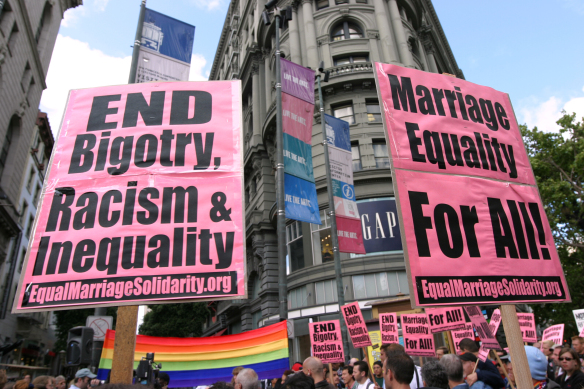
A Good Month for Equality


A million cheers for Iowa and Vermont!

In other news (I'm a future Minnesotan, after all)---when will Al Franken get his Senate seat?

In other other news, President Obama (I love saying that) was in Iraq today.

Now that the mayhem of the admissions season is over, I have some brain space left to read the news again (not just scan it.) It's nice.

PBS World: Worth Procrastinating For


A lot of good stuff on PBS World today! I should be doing my homework for fiction tomorrow, but these shows keep pulling me back in.

I have to leave the house at an ungodly hour tomorrow, ("working interview"), so I need to start trying to sleep around 7 pm. I can't remember the last time I went to bed so early.

*
Recommended Viewing!

From the PBS Independent Lens website:

In the 1920s, Zulu singer Solomon Linda composed "Mbube," a hit melody in his native South Africa. Decades later, it skyrocketed to the top of the international pop charts as "The Lion Sleeps Tonight."

A LION'S TRAIL follows this beloved song's rocky history, from South Africa to Brooklyn and back, asking why Linda died penniless---while American artists made millions off of his music.

A Global Voices film. Also features Pete Seeger. More links here.
Solomon Linda, far left, above.

*

From the WGBH website:

AfroPop: The Ultimate Cultural Exchange: Being Pavarotti

"Being Pavarotti" tells the story of a South African teen who sets out to become a successful opera singer.


AfroPop celebrates Africa's cultural and historical growth through six films. These programs, each introduced by actor Idris Elba, explore the complex lives of contemporary Africans, both on the continent and abroad. The series includes an examination of the efforts of African AIDS activists, a profile of two young South African hip-hop disc jockeys, the touching story of one Cape Town boy's love for opera music, and a look inside the blossoming Nigerian film industry.